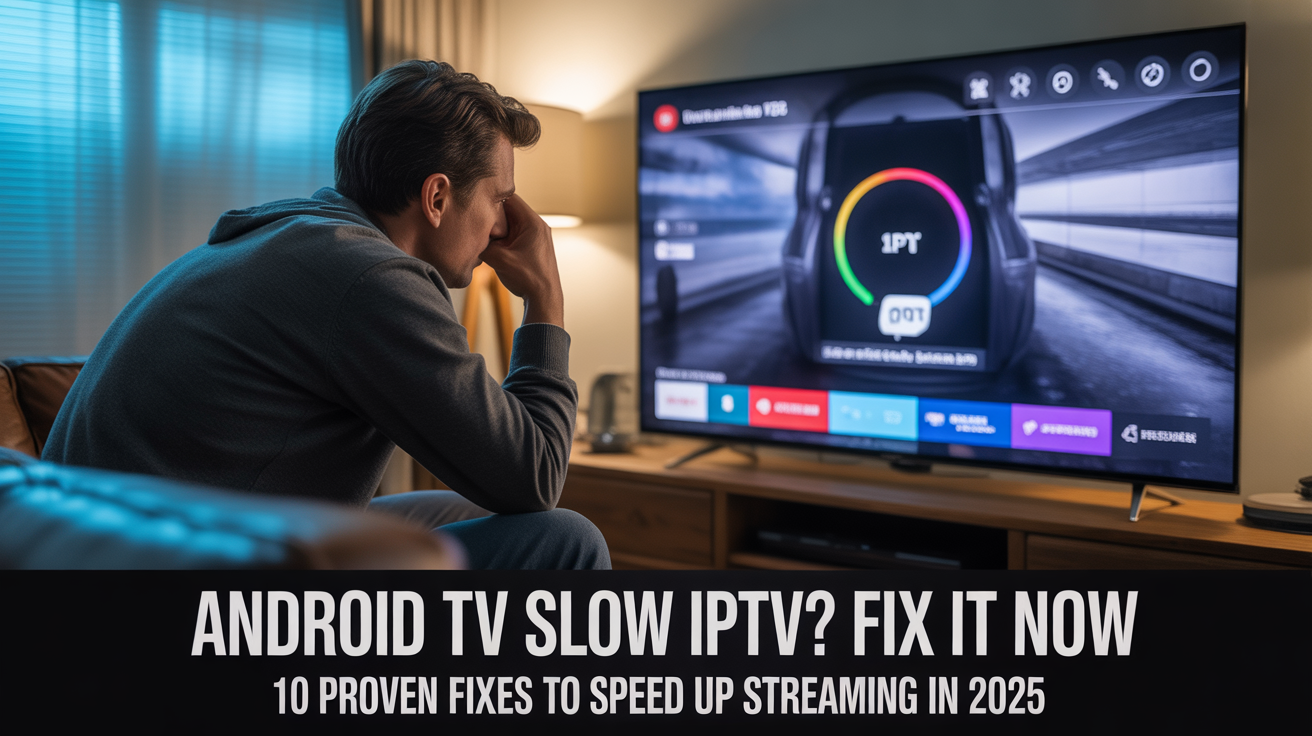
Imagine the scene: you’ve settled into the couch, remote in hand, ready to watch the biggest match of the season on a Android TV streaming IPTV experience that should be flawless. But instead of breathtaking 4K action, you get the dreaded spinning wheel. The stream stutters. The screen freezes. The audio goes out of sync. If this sounds painfully familiar, you are not alone. “Android TV slow IPTV” is the silent scream of millions of cord-cutters worldwide. But here’s the truth: your TV hardware is rarely the villain. The culprit is usually a cocktail of software bloat, network congestion, or an IPTV service that promises light but delivers shadow. In this comprehensive guide, we will diagnose why your Android TV IPTV performance suffers from lag, and give you ten battle-tested fixes to turn your living room into a streaming powerhouse. Forget the spinning wheel—2025 is the year you reclaim your digital throne.
Why Is Your Android TV Slow IPTV? The Root Causes
Every Android TV IPTV lag issue has a fingerprint. It might be background apps eating your RAM like hungry ghosts. It might be your Wi-Fi router gasping for breath under the load of five devices. Or it might be an IPTV provider with overloaded servers. Before you blame your television, understand the ecosystem. An Android TV is essentially a computer running on a modified operating system. Over time, cache files pile up, app updates demand more resources, and the system UI becomes a bloated bureaucracy. When you stream IPTV, you ask this system to decode high-bitrate video, manage network packets, and render a smooth picture—all while a dozen other apps lurk in the background. The result? A classic case of the system being too busy to breathe. Let’s tackle each layer methodically.
Fix #1: Master Your Network—The Lifeline of IPTV Streaming
Nothing matters more than the pipe that carries the data. If your Android TV IPTV buffering persists, start here. Connect via Ethernet if possible—a wired connection eliminates interference from neighbors’ Wi-Fi, microwaves, and baby monitors. For a smooth 4K IPTV stream, aim for a minimum of 25 Mbps download speed. Use an app like Speedtest by Ookla on your Android TV to measure actual throughput. If you must use Wi-Fi, switch to the 5 GHz band and place the router within line of sight. Pro tip: if your router is more than three years old, upgrade to a Wi-Fi 6 model. It handles multiple devices with the grace of a skilled juggler.
Fix #2: Clear the Cache—Your TV’s Digital Spring Cleaning
Think of your Android TV’s cache as the junk drawer in a kitchen—over time, it overflows. For Android TV IPTV slow performance, clearing the cache can deliver an immediate performance boost. Go to Settings > Apps > See all apps > select your IPTV player (like TiviMate or IPTV Smarters) > Clear cache. Do this for the System UI and Android TV Home launcher as well. A weekly cache flush is like a morning stretch for your streaming setup—simple, effective, and preventive.
Fix #3: Disable Animations and Visual Effects
Android TV animations are pretty, but they demand GPU cycles. When you’re trying to fix Android TV IPTV lag, beauty takes a backseat to speed. Go to Settings > Developer Options (if hidden, tap Build Number seven times) > find Window animation scale, Transition animation scale, and Animator duration scale. Set all to 0.5x or off. Suddenly, your TV feels snappier. It’s like removing lead weights from a runner’s shoes.
Fix #4: Uninstall the Bloatware—Kill the Vampires
Android TVs come preloaded with apps you have never opened—games, shopping channels, streaming trials. These are digital vampires, draining Android TV performance IPTV via background processes and auto-updates. Uninstall everything you do not use. If the system prevents removal, use the “Disable” option. Less clutter means more RAM and CPU for your IPTV stream. A lean TV is a fast TV.
Fix #5: Choose the Right IPTV Player
Not all IPTV players are created equal. For Android TV IPTV streaming issues, the player’s hardware decoding engine can make or break your experience. TiviMate is a fan favorite for its lightweight design and hardware acceleration. IPTV Smarters Pro is another robust option. Avoid generic players that download massive UI assets every time you open them—they turn your TV into a slideshow. Always enable hardware decoding in the player settings if available.
Fix #6: Update or Rollback Your Android TV Firmware
Android TV updates are a double-edged sword. Sometimes a new update fixes bugs; other times, it introduces new ones. If your slow Android TV fix isn’t working, check for system updates via Settings > Device Preferences > About > System update. Conversely, if you notice performance degradation after a recent update, consider factory resetting to rollback (but back up your data first). Users have reported significant gains after resetting their Nvidia Shield or Chromecast with Google TV.
Fix #7: Optimize Your IPTV Service—The Server Side
Even a perfect Android TV will stutter if the IPTV service is the bottleneck. Many free or cheap IPTV providers overload their servers, causing packet loss and buffering. For consistent Android TV IPTV performance, switch to a premium provider with dedicated servers. Test with a free trial first—most reputable services offer 24- to 48-hour trials. If the stream stays silky smooth on that trial, the problem was never your TV. It was your service. Consider an IPTV trial 2026 to experience server-side optimization firsthand.
Fix #8: Reduce Video Resolution Temporarily
If you need an immediate slow Android TV fix for a live event, drop the stream resolution from 4K to 1080p or 720p inside your IPTV player. This reduces the decoder’s workload dramatically. While 4K is glorious, a stable 1080p stream beats a choppy 4K one every time. You can always switch back later once the network or device stabilizes.
Fix #9: Manage Background Processes and Auto-Start Apps
Many Android TV launchers have auto-start features that launch apps on boot. Use a tool like “Background App Killer” or “Launcher Manager” to prevent unnecessary apps from running. Also, disable automatic updates in the Google Play Store. Nothing kills Android TV performance IPTV like a hidden 500 MB download happening while you watch the final minutes of a match.
Fix #10: Factory Reset—The Nuclear Option
When all else fails, a factory reset gives your Android TV a fresh start. It erases years of digital clutter, misconfigured settings, and corrupted cache. After reset, install only the essential apps: your IPTV player, a speed test app, and nothing else. The result is often a TV that feels brand new—and the Android TV IPTV lag issue vanishes. This is the ultimate slow Android TV fix you can deploy.
Comparison: Why Android TV Performance IPTV Differs Across Devices
| Device | Processor | RAM | IPTV Performance | Recommended Fix |
|---|---|---|---|---|
| Nvidia Shield TV Pro | Tegra X1+ | 3 GB | Excellent, can handle 4K high-bitrate | Minimal tweaks needed |
| Chromecast with Google TV HD | Amlogic S905D3 | 2 GB | Good, but buffering on heavy streams | Clear cache & upgrade router |
| Sony Bravia (built-in) | MediaTek or similar | 1.5–2 GB | Variable, bloatware heavy | Uninstall bloat & disable animations |
| Xiaomi Mi Box S | Amlogic S905X | 2 GB | Moderate, lag on 4K | Use hardware decoding in player |
| Cheap unbranded TV box | Rockchip or Allwinner | 1 GB | Poor, frequent stutters | Factory reset & use 1080p streams |
As you can see, Android TV performance IPTV varies wildly. A premium device like the Nvidia Shield requires almost no tuning, while a budget box demands constant love. But regardless of your device, the fixes above work.
The Role of Your IPTV Provider: Why EvesTV Stands Out
An optimized Android TV is half the equation. The other half is the server that feeds it. An Android TV IPTV buffering experience is often a symptom of a provider using cheap CDNs. EvesTV, for example, uses enterprise-grade servers with load balancing. Their IPTV service review for Firestick highlights how consistent performance remains across devices. For Android TV users, EvesTV offers dedicated M3U playlists optimized for hardware decoding. If you are tired of fighting Android TV IPTV lag, a visit to their premium IPTV service provider page might be the last fix you ever need.
External Resources to Validate Your Fixes
For standalone confirmation of network tips, check Speedtest by Ookla to measure your actual connection. For Android TV optimization guidelines, the official Google Android TV support page offers system-level advice. Cross-referencing these with our fixes ensures a bulletproof upgrade path.
Conclusion: You Control Your Streaming Destiny
The Android TV slow IPTV problem is not a life sentence. With a systematic approach—starting from your network and moving through software settings to your IPTV provider—you can transform a frustrating experience into one of pure enjoyment. Remember: your Android TV is a powerful machine shackled by bloat and misconfiguration. Break those chains. Clear the cache, disable the animations, uninstall the vampires, and switch to a premium IPTV provider that respects your time. The spinning wheel is the enemy. You are the warrior. Go forth and stream without limits.
FAQ: Frequently Asked Questions About Android TV Slow IPTV
- Why is my Android TV so slow when streaming IPTV?
The most common reasons are insufficient network bandwidth, background apps consuming RAM, bloated cache files, and an underpowered IPTV player. Start with Fix #1 (network) and #2 (cache clearing). - Can a cheap Android TV box ever run IPTV smoothly?
Yes, but only with significant optimization. Uninstall bloatware, use a lightweight player with hardware decoding, and stick to 1080p streams. For 4K, you need a premium device like Nvidia Shield. - What is the best IPTV player for Android TV?
TiviMate and IPTV Smarters Pro are the top picks due to their lightweight architecture and hardware acceleration support. Avoid multi-purpose media players like Kodi unless you have a powerful device. - Does factory resetting my Android TV help with IPTV lag?
Absolutely. It erases years of accumulated junk, misconfigured settings, and background processes. It is the nuclear option but often the most effective last resort. - Should I use Wi-Fi or Ethernet for IPTV on Android TV?
Ethernet is always superior. It provides steady latency and full bandwidth without interference from other devices or walls. If Ethernet is impossible, use 5 GHz Wi-Fi close to the router. - How often should I clear the cache on my Android TV?
At least once a week. For heavy IPTV users, every three days is ideal. It keeps the system from suffocating under junk files. - Can my IPTV provider cause lag even if my internet is fast?
Yes. If the provider’s servers are overloaded, your fast internet won’t compensate. Always choose an IPTV service with transparent server infrastructure and free trials to test. - Does enabling developer options void my warranty?
No. Developer Options are standard on Android TV and do not void warranties. Changing animation scales or disabling background processes is safe as long as you don’t alter system-critical parameters. - Will a VPN slow down my Android TV IPTV streaming?
Potentially, yes. A VPN adds encryption overhead and may route traffic further. If you need a VPN for privacy, choose a lightweight one like WireGuard-based VPN, and connect to a nearby server to minimize speed loss. - What is the best overall fix for Android TV slow IPTV in 2025?
Combine a wired Ethernet connection with a premium IPTV provider like EvesTV, clear cache weekly, and use TiviMate with hardware decoding enabled. That combo rarely fails.